
Dandelion Wine

I’ve returned to my seasonal rental in Monson to prepare the Appalachian Trail Conservancy Visitor Center for its opening May 30. From now through October, I’ll be spending my work week (generally Thursday-Monday) in Monson, with days off at my cabin.
Monson is a small town on the shore of Lake Hebron, with a population of 609 in the 2020 census. It’s at the southern end of the Hundred Mile Wilderness, the most remote section of the Appalachian Trail, while my cabin is about ten miles from its midpoint.
I love the wild feel of the woods around my cabin, with their rich diversity of native flora and fauna. But yards in Monson boast a botanical asset that wilder lands lack: an abundance of dandelions.
Dandelions originated in Europe and Asia. Their name comes from the French dent-de-lion – lion’s tooth – a reference to their coarsely toothed leaves. They were introduced to North America by seventeenth-century settlers, who cultivated them to use as spring greens and for a variety of medicinal purposes. The hardy plants soon escaped from the confines of gardens and began propagating on their own, becoming a resource for foragers.
Now, four hundred years later, their descendants thrive on the lawns of Monson. And I gather the blossoms for another traditional use: to make wine.
It’s pleasant work on a sunny spring day. As I pluck the flower heads, I delight in the contrast between their bright yellow petals and the fresh green of new grass. To me, a dandelion-strewn yard is lovelier by far than a monotonous grass-only monoculture.
Bees and other pollinators appreciate the dandelions too. Because they bloom so early, they’re an important food source. Though their pollen is not as nutritious as that of native flowers, they fill a need when little else is available.


In the suburban neighborhood where I lived as a child, dandelions were a disgraceful sign of a homeowner who was shirking his civic duty. ChemLawn trucks prowled our community, spraying herbicides. Yards sprouted signs warning children and pets to stay off. People thought their money was well spent and the toxicity was justified: a wildflower-free lawn was a noble achievement.
My mother Deanie and I moved to Greenville, Maine, a fifteen-to-twenty-minute drive from Monson, in December 2003. The following spring, after the snow melted, I was very happy to see that homeowners in our new neighborhood were content to let nature be their gardener.
The year after that, I decided to put the bounty of our yard to good use. I searched online for a simple recipe for dandelion wine. Deanie and I enjoyed it enough that spring winemaking became an annual tradition. At one point, I actually imported dandelion seeds from a nearby lawn, in an attempt to enhance our crop.
Here’s my recipe, which I’ve tweaked over time. It produces a strong wine, really more of a liqueur. On a cold, dark winter evening, it’s a bit of liquid spring sunshine.
I use 3 cups of dandelion blossoms, measured firmly packed. I try not to leave any of the stem attached; it reportedly makes the wine too bitter. Some recipes go further to avoid bitterness by using only the flower petals and discarding the green sepals at the base of each blossom, but I’ve never tried that method.
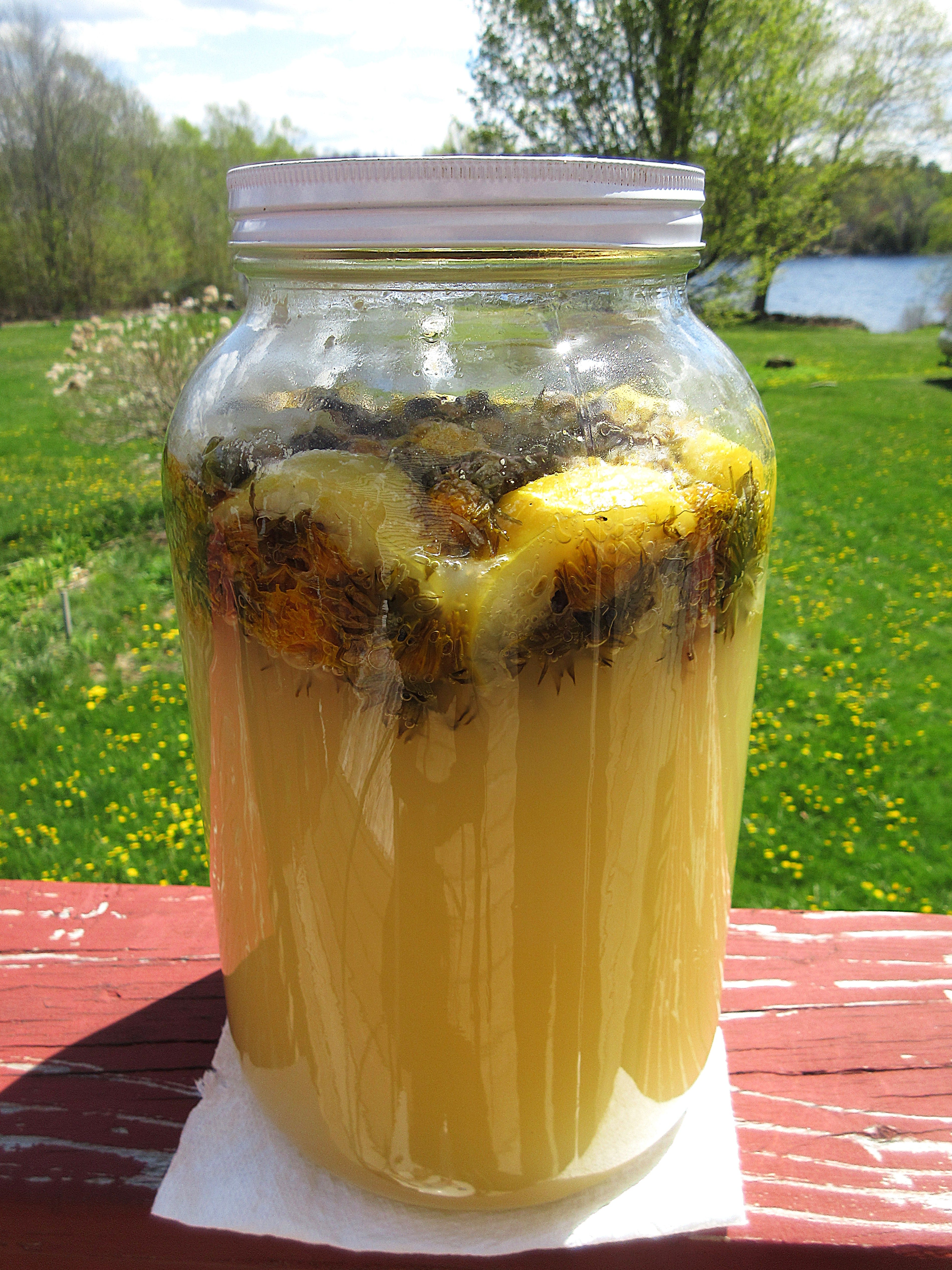
In a large pot, along with the blossoms, I add 4 cups sugar, 3/4 of a lemon (sliced, with the rind still on it), and 12 cups water, then boil for 5 minutes. I put the mixture in a jar, and when it cools to room temperature (a little warmer is okay), I add 4 1/2 tsp instant yeast. I leave the jar at room temperature with the lid loose (to let gas escape) for about 4 days. Then I strain out the dandelion blossoms and lemon. I leave the jar at room temperature for about 22 more days; I leave the lid loose for the first couple of those days, then tighten it. I re-strain the wine and taste it to see if it’s too bitter. If so, I add honey to taste, in the range of 1-2 tsp of honey per cup of wine. Then I refrigerate it in the same jar I used to make it; I don’t put it into corked wine bottles. The wine will keep in the fridge for a full year, until the next batch is ready.
If you’re passing through Monson, please stop by the Appalachian Trail Visitor Center to say hello! I’m generally there Thursday – Saturday from 8-11 AM and 1-5 PM, Sunday from 10:30 AM – 5 PM, and Monday from 8-11 AM and 1-5 PM. My usual days off are Tuesday and Wednesday, with a ridgerunner or volunteer keeping the center open when possible. You may reach us by email at monsonvisitorcenter@appalachiantrail.org or by phone at (413) 200-0313. We offer a wealth of information about the Appalachian Trail, as well as many other trails in the Moosehead Lake and Hundred Mile Wilderness regions.
Thank you, Wendy! I'm very happy to read your messages! Dandelion wine has been a celebrated wine on our prairie, too! 🙂