
Walking on Water

Each year, winter grants me a special power. When the weather is cold enough, for long enough, ice atop lakes and ponds grows thick, and I can walk on water. A new world opens to me for exploration.
I eagerly await this yearly freeze-up. After a thaw in mid-January, the gray, soggy condition of the ice near my shore discouraged me. I welcomed the Arctic air that arrived later in the month, hoping it would bring the gift of strong ice that would safely hold my weight.
I hadn’t left the woods since late December. I was planning a weekend in town over the last days of January and the first of February. After four and a half weeks at my cabin, I wanted to get supplies, pick up my mail, and do various errands. I needed to snowshoe about three and a half miles through the woods to get to my car. But on my return trip, I hoped to take a different route back home, crossing the ice of the lake from a boat launch on the opposite shore.
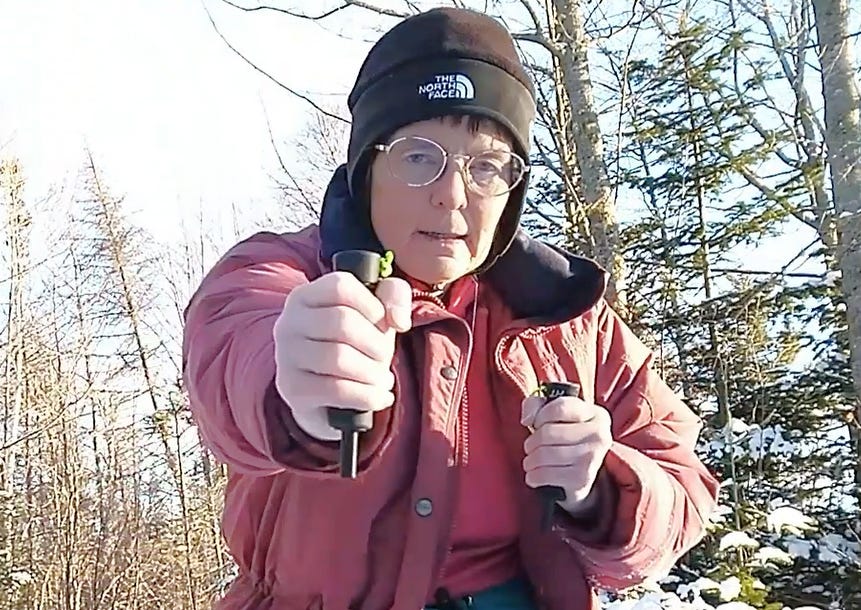
I checked with a friend who has lived in the area for decades. He’s intimately familiar with the weather conditions that solidify or destabilize ice. To my delight, he gave me the go-ahead. But he reminded me to wear a pair of safety picks just in case: two small grips, each tipped with a sharp spike. They will allow me to pull myself, hand over hand, back onto solid ice, should I break through into the frigid water below. They attach to a cord that I wear around my neck, much like mitten strings for children.
On a sunny, calm morning, I dropped my supply-laden gear sled at the boat launch and drove to the closest winter parking, about a mile and a half away. I walked back to my sled to begin my trek across the ice, a distance of about two and a third miles.
A friend from town was joining me for lunch and a tour of my cabin, which meant I would make three trips across the ice as the day unfolded: the first trip pulling my sled, the second to accompany my friend back to the boat launch, and the third to return home at the end of the day.
I confess to some trepidation about the weight of my sled. I had bought supplies for the next four and a half weeks. Fresh fruits and vegetables, frozen meats, butter and eggs are heavy. And how could I resist a few treats? I felt I deserved at least a little Valentine’s Day chocolate. There was also some laundry I had opted to take to town, rather than doing it by hand in my cabin. And of course, there was my laptop, basic survival gear in case of mishap, and the sled itself. I didn’t want to know how much it all weighed, because I was pretty sure the number would daunt me. I guessed it was roughly 75 pounds.
For journalistic purposes, I weighed all the bits and pieces after I got back to my cabin. The total came to about 98 pounds. I’m definitely glad I was unaware of that number beforehand. It might have induced me to leave the chocolate behind.
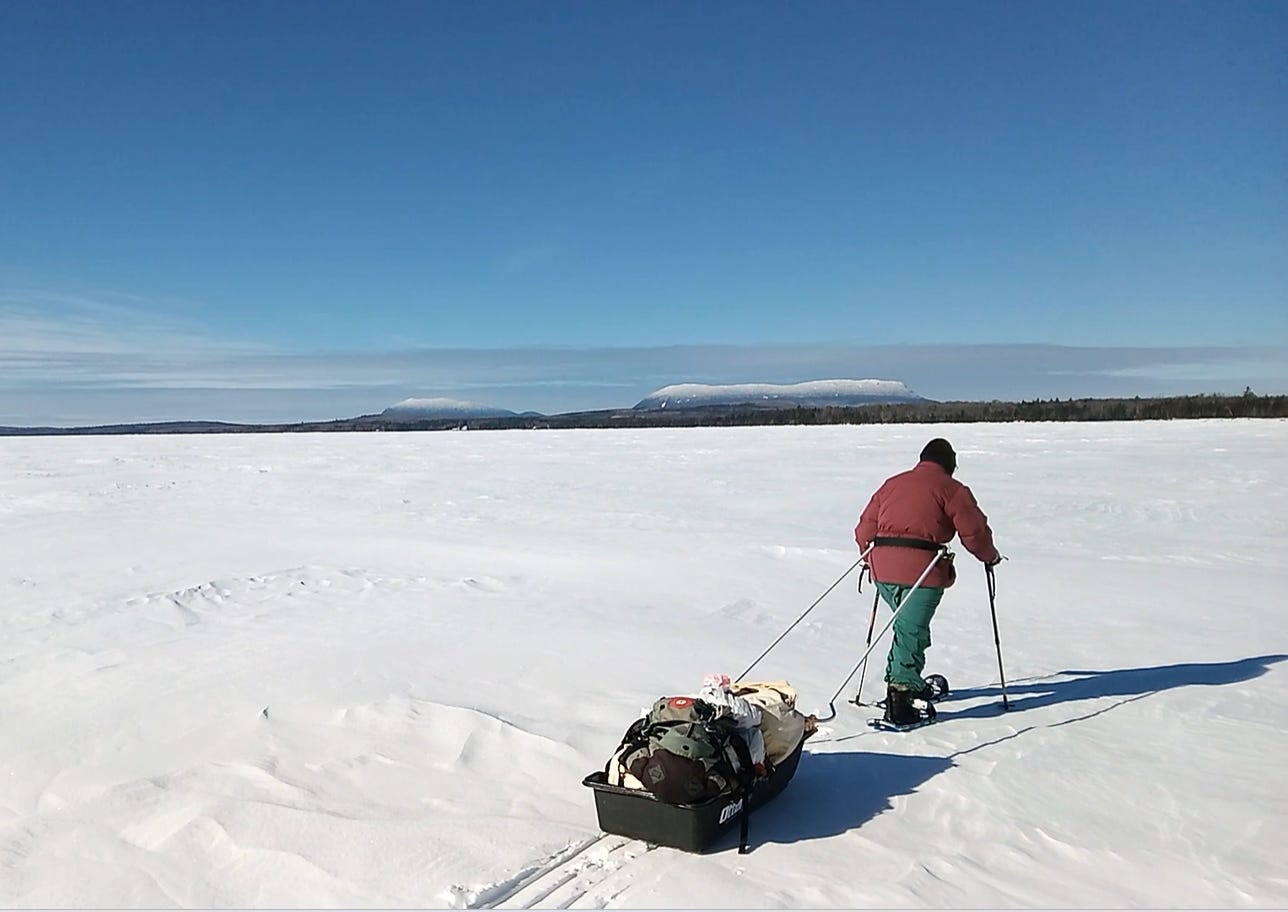
As we stepped onto the ice, I was relieved to find that strong winds had packed the snow down hard, so that I barely broke the surface with my snowshoes. The sled, despite its weight, slid along fairly easily.
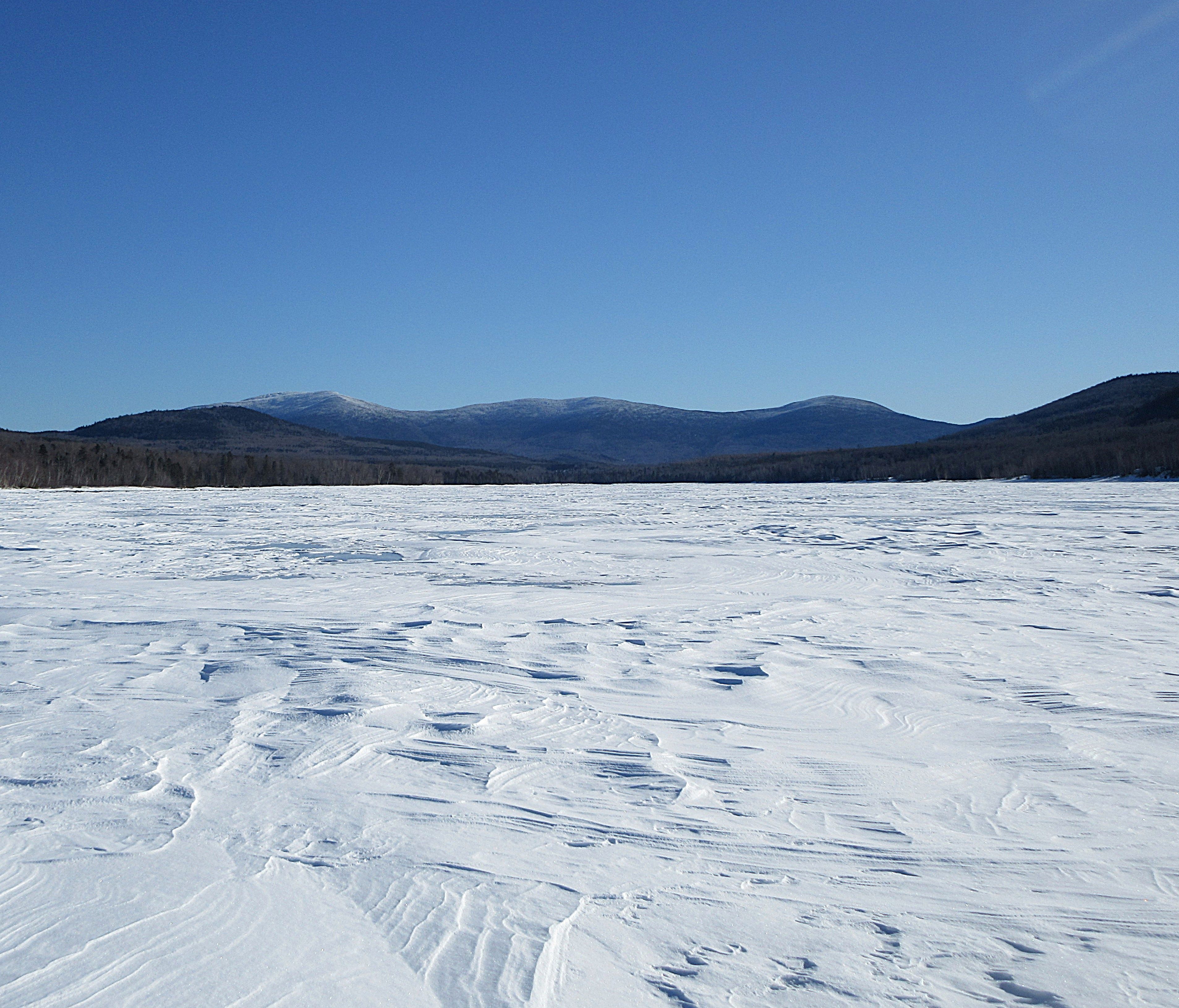
The lake was a dazzling white desert, ringed with mountains, under a dome of vibrant blue sky. To the east was the White Cap range. The Hundred Mile Wilderness section of the Appalachian Trail runs along the ridgeline.
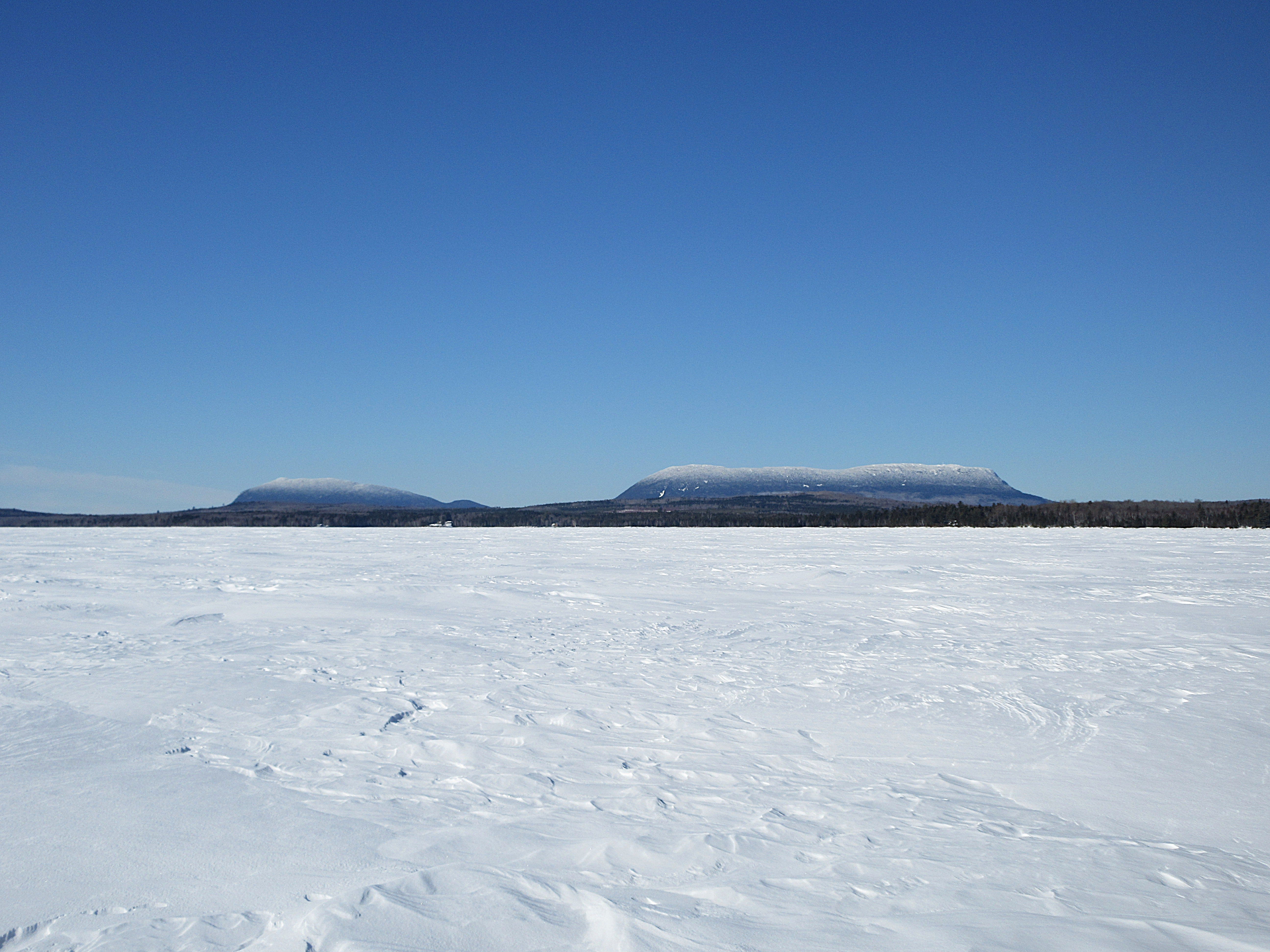
Little and Big Spencer Mountains rose above the western horizon. As I understand it, in Wabanaki tradition, these mountains are the overturned kettle and pack of Glooscap: a culture hero who taught their ancestors how to use the natural resources offered by the land. Wabanaki stories, passed down orally from generation to generation, encode maps. Long before GPS devices or even paper maps, travelers who saw the recognizable landforms would understand where they stood in relation to other places the stories described.
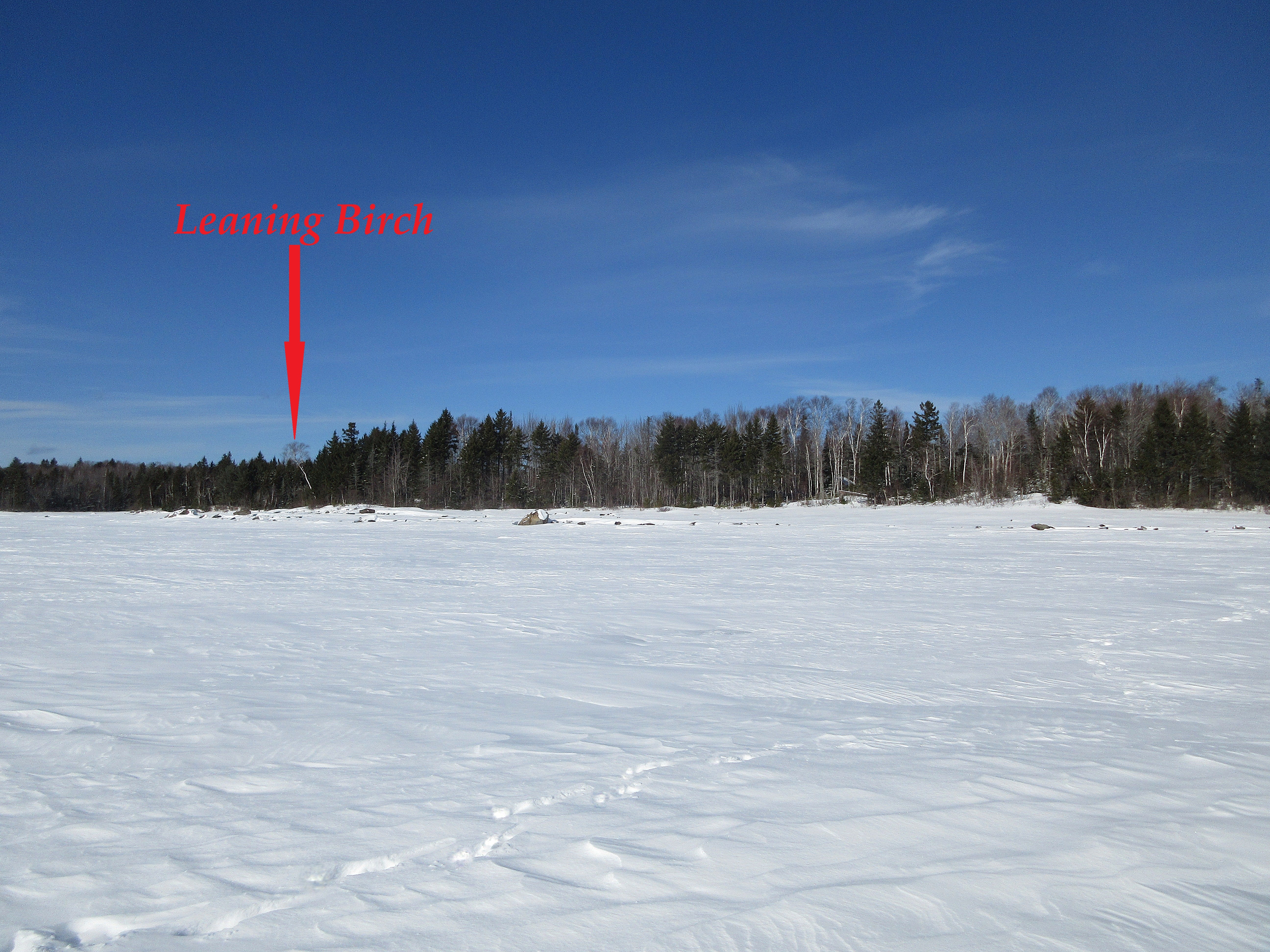
Our steps were guided by the Leaning Birch, a tree on the shore near my cabin that I’ve learned to spot from over two miles away. It grows on a point where my mother Deanie and I often watched sunsets. Her ashes are scattered at its base. As I walk toward the tree across the ice, I feel that Deanie’s spirit is guiding me home. (You’ll find an earlier post about the Leaning Birch at https://wendyweiger.substack.com/p/leaning-birch-b62.)
At my cabin, my friend volunteered to get a fire going in my woodstove. I unloaded some of my supplies and turned on my propane oven to heat a chicken-and-vegetable casserole she had made in town. Time passed quickly as we ate and talked, basking in the warmth of the flames. Shortly after sunset, we returned to the shore and set out toward the boat launch.
On our second trip across the ice, the sky was the focus of our attention. As we began walking, sunset colors lingered on the southwestern horizon. Above a rim of low hills, luminous orange melted into yellow, which faded into a faint green tinge at the edge of the darkening blue above.
The remaining daylight gradually waned. We saw Jupiter shining brightly in the east, and stars began to appear. As the sky grew black, constellations emerged. Orion the hunter strode boldly across the sky, with Sirius, a brilliant jewel in his dog’s collar, gleaming to his left. The Big Dipper pointed its cup toward the North Star, at the end of the Little Dipper’s tail.
My home is next to an International Dark Sky Park, a designation for remote locations with little light pollution. On clear, moonless nights, the abundance of stars is astounding, so many that, if I try to number them in a small patch of sky, I soon lose count. Everywhere I look, there are stars, some bright, some fainter, extravagantly strewn in clusters and clouds.
On this particular night, the moon was just past full. It was scheduled to rise two hours and twenty minutes past sunset. So the sky was not at its darkest, but the rising moon promised to entertain me on my third and final trip across the ice.
My friend’s husband picked her up at the boat launch, and I turned to go back to my cabin, pausing frequently for stargazing. When I stand alone on the ice in the dark, looking up from the surface of our spinning planet into the vast cosmos, I feel tiny, yet intimately connected with all that is.
I was a bit more than halfway back to my cabin when the moon crept above the mountain to my right. The brightness of a full, or near-full, moon reflecting off snow is another of winter’s many joys. The silvery-gray light is strong enough that I don’t need a headlamp.
My walk home was peaceful, but not quiet. As the temperature dropped, the ice on the lake contracted and emitted low booming sounds. I thought of the salmon and trout swimming in the black, watery depths beneath my feet. I whimsically imagined that they were throwing a party, playing music with a strong bass component.
As I approached my shoreline, a few brief bursts of coyote howls pierced the air. February is the peak of coyote mating season. Was I hearing the pre-mating duet of a coyote couple? I paused, hoping to hear more, but the coyotes fell silent.
I walked the same route three times in a day. But each was a different walk, offering its own unique gifts.
I had packed my stove with wood before leaving, so my cabin felt cozy when I got back. After piling more wood on the embers, I gratefully collapsed into my rocker and dozed off with my legs stretched out toward the fire.
I awakened in the “wee hours,” and decided to take one final walk down to my shore. Clouds were moving in. The moon – now directly overhead – was transformed. A coppery halo glowed around a luminous, milky white disk, with the moon shining from its center. The light pouring down on me felt like a benediction.
For anyone who would like to learn more about my gear sled, and join me vicariously on my first crossing of the ice, here’s a YouTube video. If you’d like to try “walking on water” yourself, there’s a link in the notes to a brief video with some extra safety tips.
I loved reading this! Walking on water has always been total magic to me. I grew up on an island so the ocean was never something we were granted the gift to explore on foot. I always feel like I’m half trespassing, half being let in on a magic trick when I walk on the frozen lakes and ponds here in Aroostook. I know I’ll never take it for granted. I’ve yet to make any adventures at night-I envy your star gazing!
I’ll watch your video on the sled but did you soap her up before? I pull my kids and have found it makes a huge difference. I plan to get a harness also-maybe in your video you’ll explain that. Again, thanks for sharing your wilderness experiences! I love every second of them. (and whenever I lean in to listen to the coyotes song -they also abruptly stop-I laugh and totally take it personally and apologize for eves-dropping ha.)
Beautiful pictures and images have come to mind! Thank you, Wendy.